Space Strats Devlog 05: Testing Tactical Arenas
How Space Strats separates combat authority from arena authoring and keeps mode claims honest.
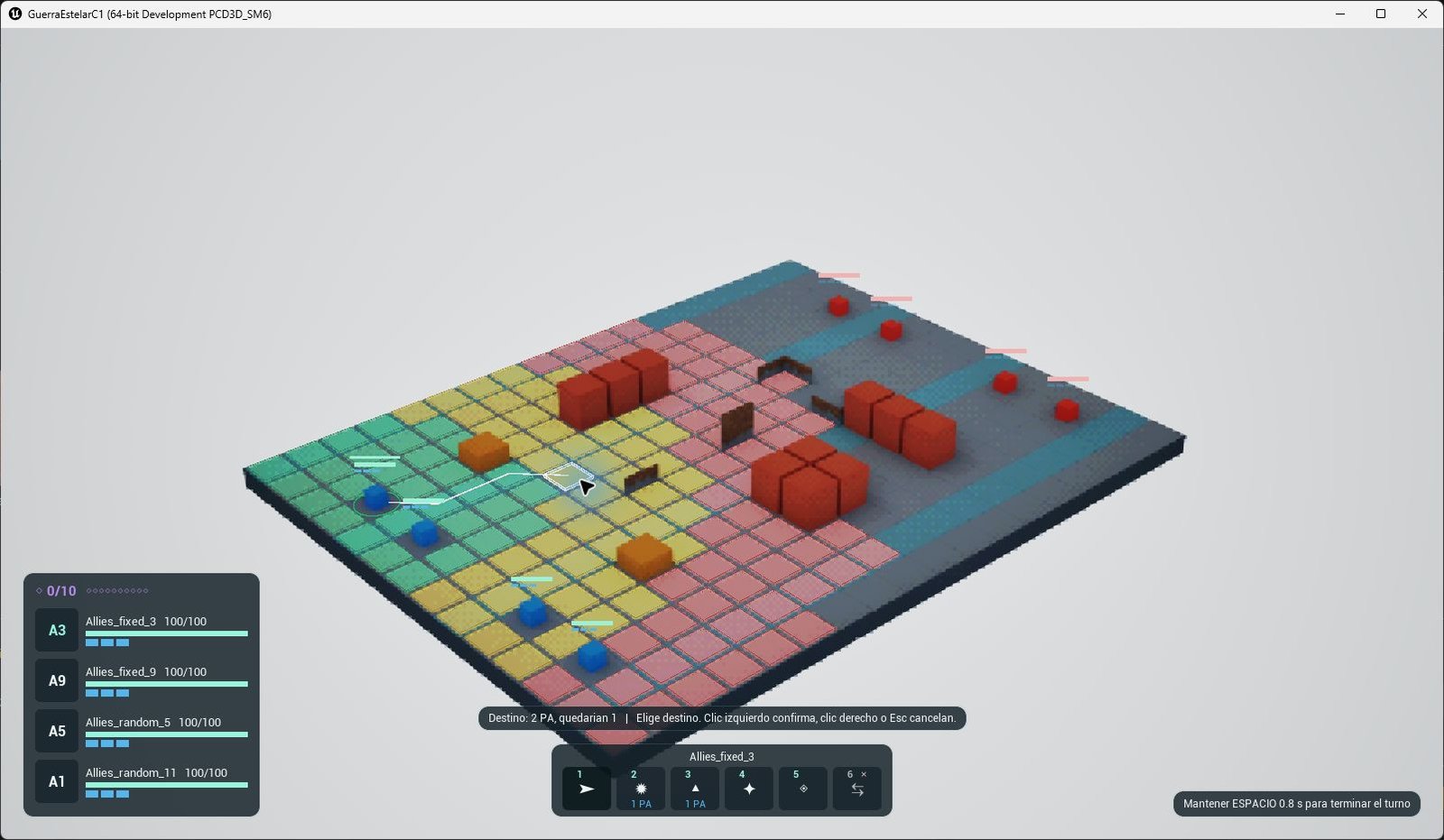
Movement preview in the separate combat scene: reachable space, a proposed route and its action-point cost, before confirmation. Captured in Unreal Engine, September 27, 2026; prototype art.
Project overview · Phase 05 / 06
Ask one tactical question at a time
Place a barrier on the approach to an objective, then test whether its directional cover changes the intended shot. The answer must come from the combat rules, not from the placeholder mesh. Space Strats keeps one tactical authority for movement, attacks, line of sight, turns, overwatch, support, abilities, snapshots, and recovery. The editor and combat UI request previews and valid actions; they do not spend resources or resolve orders.
Know what F5 actually tests
F5, or Test Map, is the editor’s interaction test. It checks map interactions and cover damage, then restores the design state when the creator returns. That is useful for validating an arena’s authoring flow, but it is separate from the playable combat UI scene. F5 does not mean the editor is running a fully integrated battle, and it does not establish a multiplayer feature.
The separate combat UI reads the tactical subsystem’s snapshot and presents intentions and results. A bridge still tests a complete endpoint crossing, not an intermediate stopping floor. A decorative pillar can frame a shot but cannot silently block movement or line of sight. These distinctions let the team compare an arena’s geometry with the rules that will actually consume it.
Define where a test begins
Spawn points can be fixed or selected from candidates, with team and group information. Deterministic selection makes a setup repeatable. Interactables and destructible cover provide additional cases to exercise in the editor test, while saved team maps give the combat developers a common set of layouts. The saved design stays separate from the temporary state of a test.
Keep mode authoring separate from scoring
Modes share the arena and keep their own element identities and explicit spawn queries. Switching mode does not reload the arena or restore cover. The authoring flow can place KOTH and CTF elements, but their scoring is not implemented. A coloured marker is not a capture rule, and an authored objective is not a finished playable mode. A draft can be saved; play validation still requires a usable configuration.
Use tests to guide the next edit
The reversible loop matters to creators. Make a cover change, use the preview, run the interaction test, and undo the whole edit if the lane no longer works. The player benefit is a map whose movement, attack, cover, and turn behaviour have a clear authority behind them. The current boundary is equally clear: KOTH/CTF scoring and a fully integrated battle remain work for a later product decision and implementation.